Saturday, 26 May 2018

Ypres Salient


I've finally made the trip I've been wanting to do for ages .... I went to the Ypres Salient and explored on bike and foot to see where my grandfather fought!

I could go on for hours about this and bore everyone to tears. Suffice it to say I've visited the grave of Reginald Parrott, and in fact had a picnic with him and Laddie Millen at their graves in the Kemmel Chateau Cemetary. 

 I then rode my bicycle on past the St. Eloi and Messines craters. In the end I made to the Hooge Crater. 


My greatest triumph was in the Sanctuary Wood area after a trip to the Hill 62 museum. 
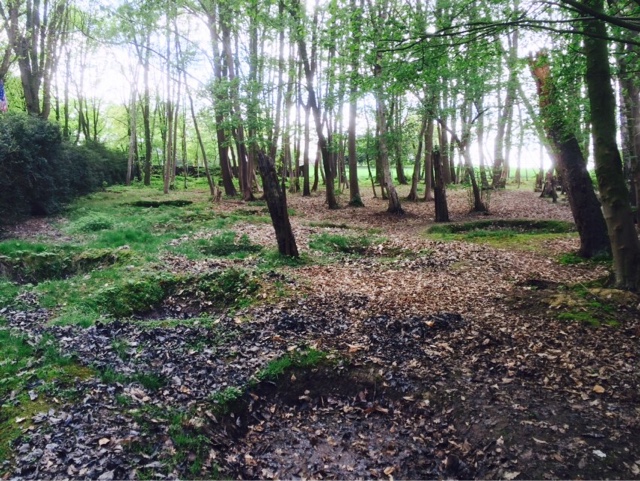


There I sought the general area of the "appendix" and "the loop" where my grandfather had been on June 2, 1916. By his account the Germans had been 35 yards away. Sure enough, when I passed up the slope I soon discovered three German bunkers… And two old shell casings. Subsequent wanderings gave me a very clear sense of the shape and topography of the land as it related to the old and new maps I had. By then it became abundantly clear that this pastoral setting was a very small space where many men fought in terror and died.  Those who didn't die escaped by the skin of their teeth in the Battle of Sanctuary Wood. 


I have a photograph of my grandfather in 1922 revisiting the culvert. I found this where you would expect, on the Menin Road, with the land at a low point and a stream passing beneath. This was just down the road from the at the Hooge mine crater, a lovely setting now next to an amusement park! 

Looking back across the battleground as I rode down Canadalaan I saw for a moment swarms of soldiers running through the field. But then I realize these were children from school group swarming through the many white markers of the Hooge Crater Cemetery.

 I was constantly struck by the present and the past, but now look at the photographs with the knowledge of the colour of the sky, the greenest of the grass, and, yes, the poppies in Flanders fields. I know the look of the earth and the rich thickness of grass when it is allowed to grow. Everything that one sees in sepia images suddenly has the immediacy of a spring day for the past was touched with a sense of those present moments that existed once, and must remain in the memories forever with the same vitality of our present day. 

Saturday, 8 April 2017

Vimy Memorial

With my Great War interest and my work with reproduction Canadian infantry uniforms you think I'd be in France right now for this weekend of commemorative hype. I tried to get a sort of invitation from some military connections I have, but nothing came through. 

Perhaps I'm just licking the wounds of my disappointment but I do find that I'm also glad not to be standing with 20,000 people recalling a battle that has been called a defining Canadian moment by some, and a nationalistic myth by others.


The original monument by architect/sculptor Walter Allward was more a memorial to loss than a beakon to national pride. As I listen to radio coverage for this weekend, and read the news papers, I'm struck that while the official view contains a nod to imperialistic jingoism, the individuals quoted speak of the loss of ancestors as something monumental in its tragedy. I suspect 20,000 people will each take from this weekend their own profound feelings of a loss and death that touches them personally. Collectively they will come away struck by the sheer number of others who share those thoughts and emotions.


Vimy will retain its meaning as long as our memories are of the individuals. As soon as we clump the experience as "national" we have missed the mark. At that point, I wonder, will the fragmented bodies of thousands be turning in their mass battlefield grave?


The photos show the War Monument in Ottawa and a half scale plaster model made in preparation for the full sized sculptures at Vimy.

Saturday, 12 November 2016

Remembrance Day 2016

Another Remembrance Day and another chance to don uniforms and mix with the commemorations. 

My two friends, Martin and Paul, joined me this year. Paul didn't want to cut off his beard so I said he could be French. This meant I had to cover my new French "bidon" water canteen and make a better set of ammunition pouches to serve the purpose. The rest of the uniform I had for him is rather more theatrical than accurate but looks the part and suited him perfectly. I dressed Martin in my 1916 Canadian leather equipment and seven button tunic. He was of the 21st Battalion. This year I decided to revert to my P'08 Princess Patricia's Canadian Light Infantry equipment and wore a steel helmet for the first time since 2013. We made a fine looking trio before walking down to the Cross of Sacrifice.


And then later on the 21st Battalion monument: 


At the ceremony we were joined by Ada, a history student at Queen's, in a nurses dress uniform from the Museum of Healthcare.


As always on these days we elicited much interest and reflection from the people we met and who came up to talk with us. I am always surprised at how touched people are that we should be there. Everyone has a memory of a parent, a great grandparent, or a great uncle who fought in the war. One woman said I reminded her of her grandfather who fought "in all the bad places". Later, at the pub, we were mobbed for photographs. At the end of our meal it turned out that some military person, who had left half an hour earlier, had paid our bill for us. There is clearly a deep and profound undercurrent of memory in so many people on this day. The evocative power of reproduction uniforms can bring forth those thoughts for each individual person's own reflection.

Looking at old photographs one must always think of the tragedy and waste of so many lives. Yet in the faces of those from one hundred years ago there is an undeniable sense of giddiness, a look strangely at odds with the grim reality of what was happening. Remembrance Day is a very somber day, apparently vital for our sense of connectedness to other humans. Yesterday I also witnessed some of that giddiness. But that, too, is important and keeps us together.


Tuesday, 31 May 2016

Sanctuary Wood


We're  at that point in the Great War centenary where people are reflecting on Verdun and, a month from now, the Battle of the Somme.

In the Hooge sector, east of Ypres, Princess Patricia's Canadian Light Infantry was holding the line with other battalions. They were in an area called "Sanctuary Wood", so named because it was quiet at the start of the war. My grandfather, Grant MacLachlan, was there and took these photos:


He was a machine gunner. Here's another picture of him ready and waiting.


The line was held, but it was considered to be un-tenable with its strange indentations known as "The Loop" and "The Appendix". The understanding was that if attacked the line was to be withdrawn to staighter communication lines.

 Here is the view on June 2, 1916.


By this point in the war the Wood was anything but a Sanctuary, as can be seen by the blasted trees. And it is no longer a wood.

On June 2 the Germans opened up with a barrage. The Battle of Santuary Wood began. As planned the Allied line slowly retreated as the German advance began while still holding the Germans back. Each battalion had tales of successes and losses over the next few days. PPCLI was no exception. When they were finally relieved on the 5th they had taken a hard knocking.

My grandfather took this picture of No. 5 platoon after their part in the battle was over:


Knowing what happened on an individual level is hard to fathom. 

In 1922 my grandfather returned to visit the Front with his dad and his cousin Louise. Several photos show him at "The Culvert" along the old rail line.


I can only imagine that this is what he and his comrades fell back to, and where they were able to do their bit to hold the German advance. Here must be where he set up his gun and fell into exhausted sleep, if sleep was possible, while mayhem screamed around him for three days. He stands here reflecting on fears and relief that he survived where others did not.... But I don't know.

Meanwhile on this same pilgrimage his father, Alexander MacLachlan, and his cousin Louise look at a deserted tank. Was the crew blown to bits?:


And they photograph mountains of collected barbed wire:


And Louise makes a light hearted and dangerous gesture with a rusty German grenade. Lucky she wasn't blown to bits:


Meanwhile, back in Ypres, reconstruction begins


Sunday, 14 February 2016

Reginald Elsworth "Polly" Parrott

I've always felt closer to Reginald Elsworth Parrott than "Laddie" Millen because I have a photo of him standing, living, with my grandfather in November 1915. He, especially, looks young and gentle, and anything but a soldier.


He died on March 5, 1916, after being buried alive when a German retaliatory bombardment collapsed the parapet. He was 20. My son just turned 21.

Here's a picture of my grandfather visiting Parrott's grave in the summer of 1922. "Laddie" Millen's grave is next to it, to the right and outside the frame.


In 2006 I was there with my son, then aged 11. 


My sister-in-law has been since. I also have a small vial of earth from his grave that I've been sprinkling at opportune moments in such places as the War Memorial in Ottawa and on a movie set where I was an extra in a trench a few years ago. By these small acts we try to remember those who might be forgotten. 

Are there any Parrott relatives out there? Contact me. Reginald Parrott was the son of John Parrott, Mayor of Saltcoats, Saskatchewan.


Wednesday, 10 February 2016

John Ernest Lysle "Laddie" Millen

In these years there must be hundreds of significant Great War centenary dates just passed, or soon to come. For the Western Front people are anticipating the Battle of Verdun and the start of the Battle of the Somme.

But every day there is a centenary passing for hundreds of men who died less historic deaths in the trenches. In this blog posting, and the next, I want to remember two men. These men were friends of my grandfather's. They fought with Princess Patricia's Canadian Light Infantry.

"Laddie" Millen worked as an advertising manager before enlisting as part of the 1st University Company that restored numbers to PPCLI in 1915. I know nothing of him but what is written in the book " With The Patricia's in Flanders ". He seems to have been particularly liked by the other men and I can imagine him being light hearted when others were feeling quakey. He must have made his comrades feel good to be alive and feel like picking up their step when spirits were lagging. 

He was shot in the head by a sniper and died on February 19, 1916. He was twenty one years old. This terrible photo was stolen from the web.


As I said, my grandfather was a friend of his. I believe he was the man in one of three stories my grandfather told me when I was thirteen. He told me that he had to relieve a man on sentry duty. As he took up his position the other man yawned, reaching up and stretching. His head went above the parapet and at that moment the sniper had his target. The shot from 700 yards was perfect. As my grandfather told me he held his dying friend in his arms, the top of his head removed like the top of a boiled egg, his brains utterly exposed.

Was this man "Laddie" Millen? I can't be certain but the point is he might have been. In the end what I believe may be what is important because it is in remembering the individuals that we can begin to appreciate the size of the slaughter, and that each death amongst the millions was a devastating tragedy to those left behind, whether distant family or trench mates who remembered the moment for decades and passed that memory to their grandchildren.

Wednesday, 11 November 2015

Remembrance Day and Red Poppies

I did my bit for Remembrance Day again. This time I had my friend, Paul, with me. It was nice to have company and we set off across the park in our Great War Canadian uniforms. At the 21st Battalion memorial a few cadets were getting ready, one in a Great War uniform I had helped acquire for the Princess of Wales' Own Regiment. That made three of us in uniform, and I knew my friend David was tending his gallery in uniform and two other uniforms were variously on display. Tim's battalion was showing a sixfold increase over last year. Paul and I greeted the cadet before walking down the scarlet line of RMC cadets getting ready near by. I was pushing my vintage bicycle and sporting the white poppy together with the red and copper ones from years before. Did anyone notice?


The truth is Remembrance Day is very much a red poppy event. Everyone who attends has a story of a parent or grandparent who served. Everyone has a son or a daughter who is serving. Many are veterans themselves. And far from being a time of overt jingoistic patriotism I found it to be a time of thoughtful reflection and regret, of fear and concern, and of hope.

Paul and I stood amongst the civilian contingent, since that's what we really are, and afterwords we met and talked with people. No one was disturbed by my white poppy and those who asked questions of it seemed intrigued. My grouping of poppies opened gates of reflection amongst people who had only met that moment. We all seemed to embrace the white poppy, but in light of the shared remembrance of families which had suffered through the losses of soldiering, we acknowledged the visceral strength of the blood red poppy as a symbol.


Like it or not we do have a national history of war and accompanying death. It is a national experience we must remember. The red poppy certainly speaks to this past, and I think the white speaks for the future. I will be wearing both again next year.

Saturday, 7 November 2015

Remembrance Day and White Poppies

Remembrance Day approaches and I prepare for my ritual appearance in the uniform of a Great War Canadian soldier, this year in the 1915 equipment. This is the equipment that I was researching a year ago, and about which I was sending information, measurements, ideas, and mock-ups to Ashok, in India. From this a set of reproduction 1915 leather equipment has been created including the 1915 haversack, an adaptation from the Oliver Pattern haversack from the 1890s.


This is getting pretty arcane. Why do I do this? On the one hand I am certainly wishing to show off something for which I am proud and find delight in its existence. On the other hand, in the context of Remembrance Day, I am also waving the Canadian flag in some sense and representing that which we nationalisticaly admire and honour. Of course, I hope to elicit the usual interest from the other bystanders who will come to me with interesting tales to tell of the great uncles and grandfathers who fought and died on the Western Front. That part I like best, but do I really want to be seen as a flag waver? I would say that my purpose for being there is that I am remembering my grandfather's unlucky friend, Reginald Ellsworth Parrott, who died March 5, 1916, buried by a parapet that collapsed after a German retaliatory bombardment. "Polly" Parrott, as he was called by his mates, is seen standing to the right behind my grandfather. This is a studio photograph taken at the Somme, November 1915, one hundred years ago this month. "The Somme" did not yet have its resonance with such slaughter in a single day on July 1 1916. That was to come. But these young men are not warriors out to kill. They strikes me, rather, as having barely left boyhood behind, and they're out for a lark.


My reasons for being at Remembrance Day are my own, and that is all well and good, but what if I'm seen by others to be supporting something that is counter to my intentions? Anyone on Remembrance Day has to acknowledge that even by being present they are, in some sense, in support of Canada's role within a military context. Words such as "honour", "valour", and "sacrifice" are presumed to be embraced by all of us. Thankfully, the word "God" is not so much used.


On November 5 I participated in a memorial held by a local chapter of a group called Peace Quest 
( http://peacequest.ca/  ) in support of an organization called "The World Remembers". Here is a link for this organization: http://www.theworldremembers.org/

Essentially, their intention is to use Remembrance as a way to commit to positive actions and intent which seek to ensure peace without war and conflict. At this event, with the participation of local artists, especially writers and musicians, we saw war as an affliction which affects combatants and noncombatants alike, and equally on all sides.

I had expressed my interest in participating with one of my Canadian uniforms. I was quickly instructed, prior to this event, that participation would require that a German uniform given an equal ranking and space as the Canadian uniform. I was able to oblige. I resurrected my some-what theatrical German uniform from a few years ago and with the addition of new reproduction belt, leather pouches, and a newly minted German backpack of my own making, I was able to give a good rendition of the German soldier in the early days of the war, compete with picklehaub helmet. This is a bad photograph, but here it is:


I think the stand of these organizations is best symbolized in the white poppy. Historically this symbol started in England when people wished to remember the war and to say that war must never happen again. This was a grand aspiration that also produced the League of Nations and, some might argue, Neville Chamberlain's conciliatory approached the Adolf Hitler. Sadly, the aspirations of all people to a world without strife, or conflict, or bloodshed, seems unattainable these days.


This year, I shall be at the usual Remembrance Day ceremony, in my uniform, wearing my red poppy, and thinking of my grandfather's friend. I will also be wearing a white poppy. To wear a red poppy on Remembrance Day is to embrace the still prevalent line, that our soldiers sacrificed themselves for a greater cause. I find myself thinking, increasingly, that young men and women die in wars because more powerful forces, be they warlords, politicians, patriotic pride, or industrialists, have failed to create a world where peaceful coexistence is possible or even wanted. Soldiers may be led to believe that they are sacrificing themselves, but I think there are, rather, sacrificed by others who stand to gain power and profit from the outcome of the world they are creating.

A hundred years ago millions of young men were slaughtered, and unenlisted civilians died, because kings and emperors were unable to curb their desire for kingdoms and empires. Had every citizen declared "the emperor has no clothes" then a very different history of the world would have unfolded. I would not be spending my time foolishly making reproductions of Canadian leather military equipment from the time my grandfather was a mere teenager. I'm sure he, and Polly Parrott, would be glad to be remembered, but I don't suppose suppose either of them would wish for the world history that has passed in the hundred years since their sorry sacrifice.


Saturday, 9 May 2015

Remembering the 21st Battalion, John McCrae, and PPCLI

The commemorations, for which I have been working so much and creating these past blog postings,  have come and gone.

I feel like a bride's mother who has been preparing for a wedding for months, then suddenly the wedding happens and it's all over. Time passes and everything ends. Does the bride's mother think "what was this all about"? Wasn't time supposed to stop in a perpetual and universal moment of recognition?


A group of us in uniform spent the Saturday of May 2 handing out brochures about the official commemoration to take place on the Tuesday. That day, the 5th, we marched in slight confusion with the smart and capable Regiment for whom this whole commemoration was organized. ( Princess of Wales' Own Regiment ). Like a wedding it was gone in the moment without even confetti to sweep up.


But, it was our moment with all its foibles. It was our time to experience thoughts and ideas and to reflect on things which would otherwise have been forgotten. 

One of our group did some busking, singing songs from the 1900s. He later met an old, old, man hobbling up the street with a walker. He told him of the centenary we were commemorating. The old man remembered stories of his father leaving on that very day from Kingston. Tears welled in his eyes. We had done something right.


Similarly, on May 3, I was at a centenary commemoration of the writing of John McCrea's poem "In Flanders Fields". I had presumed it would be an event that all of Canada would attend. I was very much mistaken since the only public there were people with some sort of deep connection to the poet, and otherwise it was a moment of regimental recognition with lots of military columns.


May 8 was the hundredth anniversary of the Battle of Friesenberg. My grandfather fought with PPCLI in November 1915, so he was not a part of that battle which tested the regiment to the full. He always had a print the famous painting of the battle in his office, and I now have that painting myself. Yesterday I let my thoughts pass over the idea of that battle in respect for my grandfather's feelings. I don't think that was any less a commemoration for not having grand and perfect fanfares and marching regiments.


Tuesday, 17 March 2015

A Kingston Great War Commemoration


In preparation for the commemoration we are having in May I'm pulling together uniforms from various sources. I have my own collection and I have two friends, but I am also getting some support from other interested people. The net result has been a lot of ordering of parts and consolidation, plus stitching, ironing, and generally preparing uniforms so they look, well, uniform. This has also meant that I have had to get badges made. More of that in another blog, and photos to follow here later.

All this has created collections gathering at my house, and I can't resist photographing the groupings. Here is a selection:


The pouches, above, have just been soaked and pressed out, and are drying on a heater.


Six sets of bayonets in scabbards become a pattern, the individual purpose lost in a group. The concept of a thousand, or six hundred thousand, suddenly takes form with a shock like a glimpse of infinity. But those are the real numbers, and it doesn't stop there.


This picture above shows the 21st Battalion for whom this quest to provide uniforms is driven. This has to be about a thousand men right here.

For this commemoration we're observing the departure in May 1915. Since this predates the development of the steel helmet we will all be wearing stiff Service Dress Caps. Here's the collection:


In order to get these ready I got into some more badge casting. Here's a selection for what I now have for sale in my Great War reproductions blog.


April...

I've just done a new round of nurses' buckles which makes for another large grouping.


Thursday, 8 January 2015

Canadian Great War Nurse's Uniforms

This is a brief update on the plan for the commemoration in May. 

The quest for resources to acquire infantry uniforms is moving well but I must make ground on the nurses' uniforms. I think I have found a supplier but will need money equal to the infantry uniforms. If any one wishes to sponsor parts of Canadian Great War nursing uniforms to this worthy cause please contact me. 


This is what we hope to purchase, but harder to find is the correct belt. I'm in the market to buy one if anyone has a Canadian nurse's belt for sale. Failing that I'm currently borrowing a buckle and will be reproducing it. You can follow this effort in my blog on Great War artifacts.


Update: March 2015. Here's the reproduction. These can be bought through my reproductions blog.


Here's a photo taken on May 5, 2015 at the commemoration of the departure of the 21st Battalion and the Queen's University Stationary Hospital Corps. All the uniforms came together in the last week, including the exquisite work done on the nurse's dress uniform, for which I was honoured to be able to make the buckle.